43% of Builders Cut Prices in October: How Buyers Can Compare Incentives Without Missing the True Cost
NAHB says 43% of builders cut prices in October and 65% used incentives. Here is how to weigh a price cut against seller credits and permanent or temporary rate buydowns.
By Anthony Brikho · 5 min read
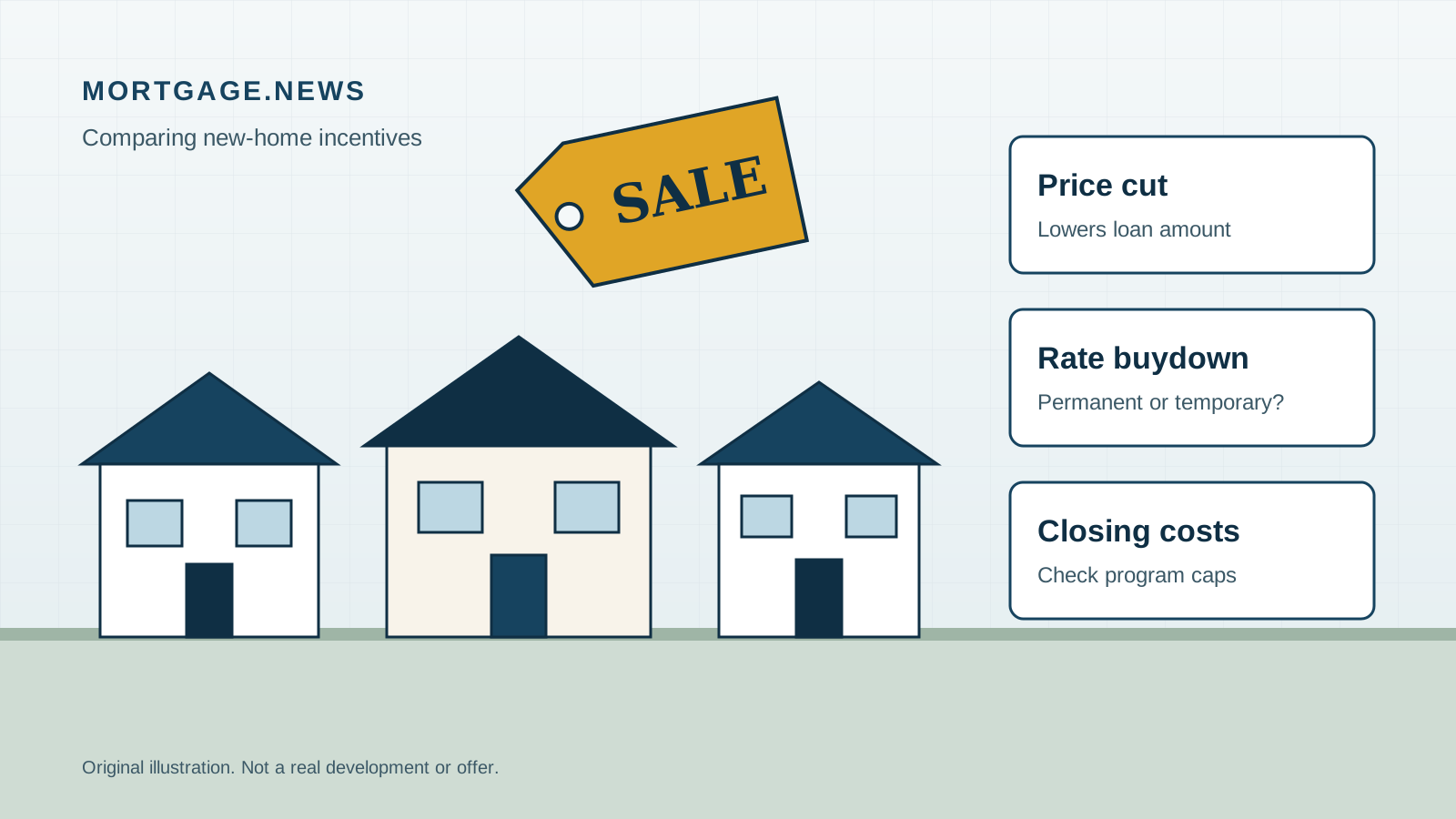
Builders are leaning harder on discounts to move new homes. In the National Association of Home Builders' October survey, 43% of responding builders reported cutting prices, the highest share NAHB has recorded during the 2020 to 2026 period, and 65% reported using sales incentives. For buyers shopping new construction this fall, that means more room to negotiate, but also more offers that are hard to compare side by side.
What the latest data show
The NAHB/Wells Fargo Housing Market Index, released October 19, 2026, fell three points to 29, the lowest reading since June 2012. Among builders who cut prices, the average reduction held at 6% for a seventh straight month. October was also the 19th consecutive month in which at least 60% of builders used incentives. These shares describe builders answering NAHB's monthly survey, not every home for sale or every buyer.
Sales have softened as well. Sales of newly built single-family homes fell 0.6% in September to a seasonally adjusted annual rate of 676,000 and were 5.3% below a year earlier, NAHB reported October 27 from Census and HUD data. The median new-home price was $400,400. Financing remains expensive: Freddie Mac's Primary Mortgage Market Survey put the average 30-year fixed rate at 7.24% as of October 29, down from 7.32% a week earlier. That is a national average for a defined borrower profile, not a quote for any individual loan.
Know which incentive you are being offered
- Price reduction. Lowers the contract price, which can reduce the loan amount, the down payment needed for a given percentage and, in many places, the value on which property taxes are eventually assessed.
- Seller or builder credit. Money applied at closing. Loan programs limit how much a seller may contribute, and those limits vary by program and down payment.
- Closing-cost assistance. A credit toward lender, title and other settlement charges. It saves cash upfront but does not change the monthly payment.
- Permanent rate buydown. Prepaid discount points that lower the note rate for the life of the loan.
- Temporary buydown. Funds that reduce payments for the first year or two, after which the payment rises to the full note rate. The interest rate on the note itself does not drop.
Some builder incentives also require using an affiliated lender or title company. That can be legitimate, but compare the affiliated offer against at least one independent Loan Estimate for the same loan.
An illustrative comparison
The figures below are a hypothetical example, not an offer or prediction. Assume a $400,000 home, 10% down, a 30-year fixed loan at 7.24%, and a builder willing to spend $24,000, or 6% of the price. Payments are principal and interest only, before taxes, insurance and any mortgage insurance. The permanent-buydown rate is an assumption; what a given amount of points actually buys varies by lender and day.
| Option | Loan | Monthly payment |
|---|---|---|
| No incentive, 7.24% | $360,000 | $2,453 |
| Price cut to $376,000, 7.24% | $338,400 | $2,306 |
| Permanent buydown to assumed 6.50% | $360,000 | $2,275 |
| 2-1 temporary buydown | $360,000 | $1,986 yr 1; $2,214 yr 2; $2,453 after |
Illustrative calculations by mortgage.news using the October 29, 2026 Freddie Mac average. Not a rate quote.
In this example the permanent buydown produces a slightly lower payment than the price cut, but the price cut also reduces the down payment by $2,400 and the balance owed. The temporary buydown looks cheapest early, yet from year three it carries the same payment as taking no incentive. If you sell or refinance within a few years, the trade-offs shift again, and any unused buydown funds are typically handled under the loan program's rules.
How to compare offers
- Request Loan Estimates for each scenario using the same loan amount, term and lock period, and compare APR alongside the note rate.
- For points, divide the upfront cost by the monthly savings to find a break-even period, then ask whether you expect to keep the loan that long.
- For a temporary buydown, confirm you can afford the full note-rate payment and ask which rate the lender uses to qualify you.
- Add property taxes, homeowners insurance and any HOA dues before judging affordability.
- Ask whether the incentive depends on a preferred lender, a closing deadline or a specific home, and get the terms in writing.
What to watch
NAHB's next Housing Market Index will show whether price cuts keep spreading, and Freddie Mac publishes its rate survey each Thursday. For an individual buyer, though, the useful number is not a headline share of builders. It is the total cost of your specific home and loan, compared option by option.
Sources: NAHB, Oct. 19, 2026; NAHB, Oct. 27, 2026; Freddie Mac PMMS, Oct. 29, 2026. Cover: original illustration by mortgage.news.