Commercial Mortgage Delinquencies Rise in Q3 as CMBS Rate Reaches 4.97%
MBA's third-quarter survey shows delinquency rising for CMBS, life company and GSE commercial loans, while FHA multifamily improved. Office remains the weakest property type.
By Joseph Salem · 4 min read
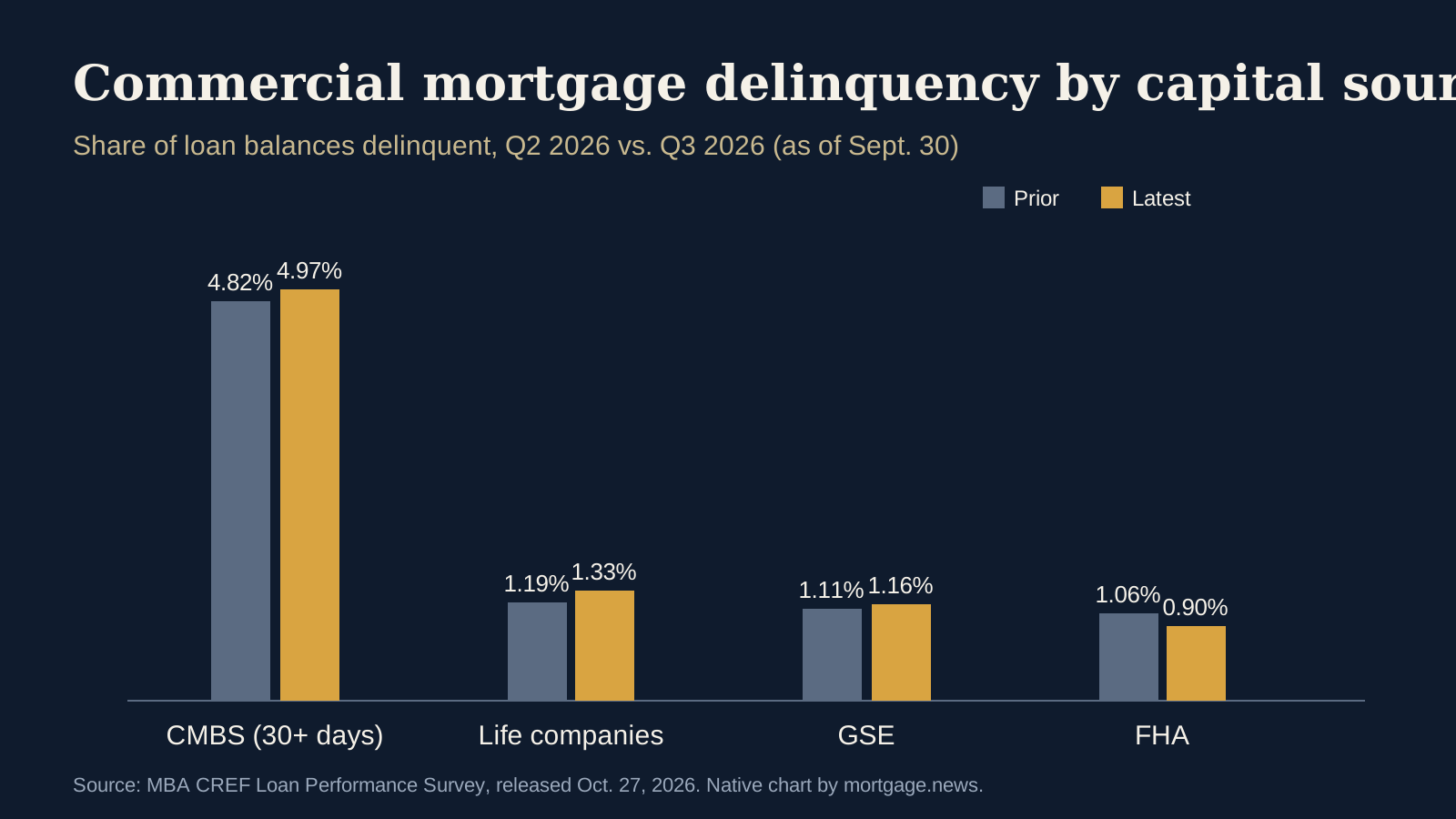
Delinquency rates on commercial and multifamily mortgages rose in the third quarter of 2026 at three of the four major capital sources the Mortgage Bankers Association tracks, according to MBA's Commercial Real Estate Finance Loan Performance Survey released Tuesday, Oct. 27. Loans held in commercial mortgage-backed securities again showed the highest rate.
The quarter by capital source
| Capital source | Q2 2026 | Q3 2026 | Change (percentage points) |
|---|---|---|---|
| CMBS (30 or more days delinquent) | 4.82% | 4.97% | +0.15 |
| Life insurance companies | 1.19% | 1.33% | +0.14 |
| GSEs (Fannie Mae and Freddie Mac) | 1.11% | 1.16% | +0.05 |
| FHA | 1.06% | 0.90% | -0.16 |
Source: MBA CREF Loan Performance Survey, Oct. 27, 2026. Each capital source uses its own delinquency definition; the CMBS figure is 30 or more days.
FHA-insured multifamily and health care loans were the exception, with delinquency falling to 0.90% from 1.06%. MBA said rates outside CMBS remain relatively low compared with their historical norms.
Office still the weak spot
MBA said the trend by property type was mixed and that office loans continued to have the highest delinquency rates. The association did not attribute the change to any single cause in its summary, but Mike Fratantoni, MBA's senior vice president and chief economist, pointed to "challenging fundamentals, particularly in the multifamily and office markets, along with higher rates."
He also flagged refinancing pressure ahead. "The large number of scheduled maturities coming due amidst the recent spike in interest rates will continue to be a headwind for commercial mortgage performance in the quarters ahead," Fratantoni said.
How big the sample is
Survey participants reported on $3 trillion of loans as of September 2026. MBA said that represents 59% of the $5 trillion in commercial and multifamily mortgage debt outstanding as of the second quarter. That is broad coverage, but not every loan, and the capital-source figures should not be added together into one market-wide rate.
What this does and does not say
These are loans on office buildings, apartment complexes, retail, industrial and other income-producing property, owned by investors and businesses. The survey says nothing about payment performance on single-family home loans, and it should not be read as a signal about residential borrowers. Multifamily lending does touch renters indirectly, since property owners under refinancing pressure may change how they operate buildings, but the survey does not measure rents or tenant outcomes.
For lenders, brokers and investors in income property, the more practical takeaway is the maturity calendar Fratantoni described: loans written at lower rates that must refinance now face higher costs, and lenders will look closely at property income and valuations before extending.
Source: Mortgage Bankers Association, "Delinquency Rates for Commercial Properties Increased in the Third Quarter of 2026," Oct. 27, 2026. Cover: native chart by mortgage.news from MBA's published rates.