Pending Home Sales Drop 7.3% as Higher Rates Challenge Fall Buyers
September signed contracts fell in every region, while completed sales rose 1.5%. NAR’s reports measure different transaction stages, underscoring the need to compare local conditions and full financing costs.
By Anthony Brikho · 5 min read
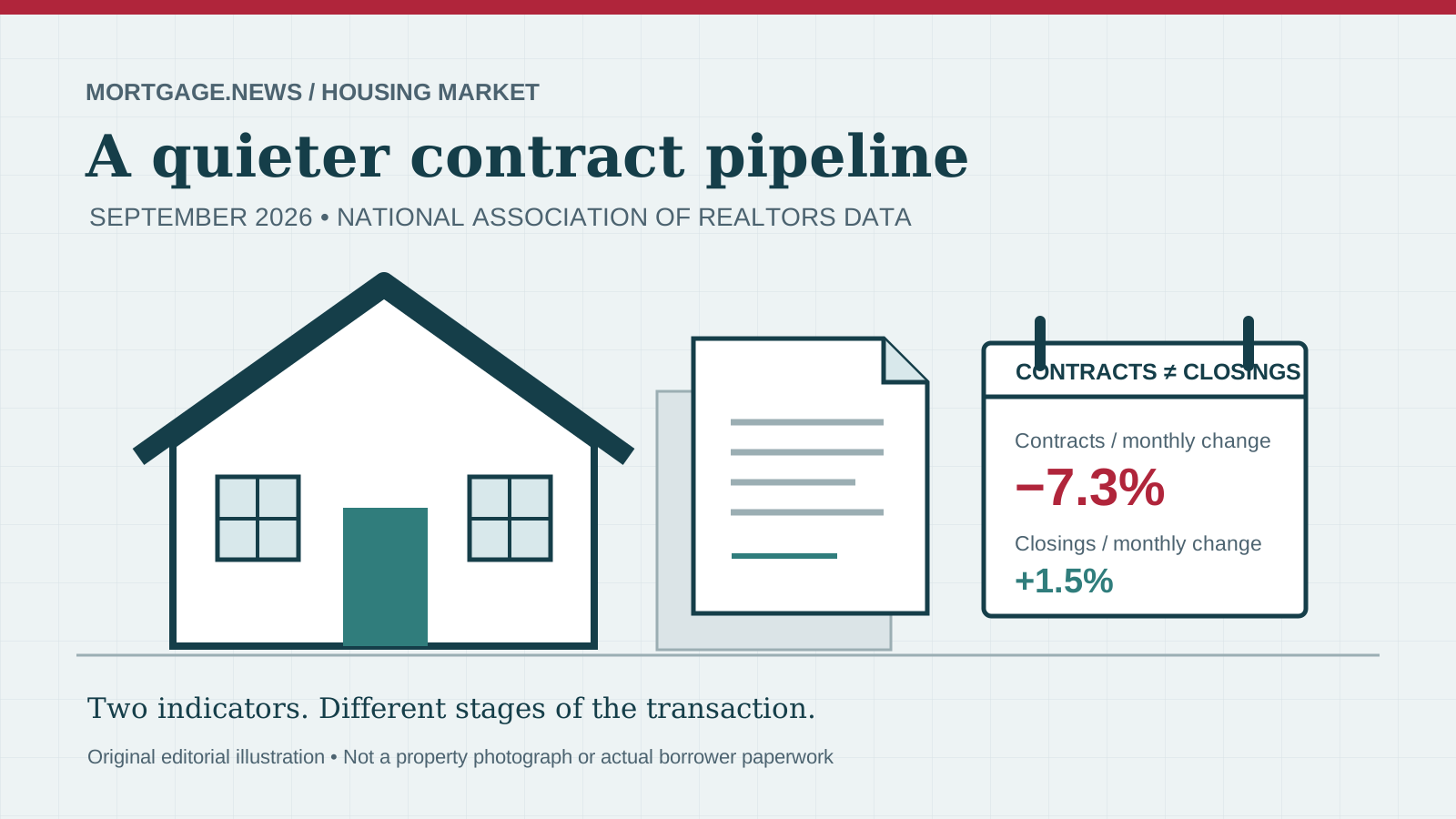
Fewer buyers signed contracts to purchase existing homes in September, even as more previously negotiated purchases reached the closing table. The split is a reminder that housing reports measure different stages of a transaction, and that a stronger month for completed sales does not necessarily mean a stronger pipeline.
The National Association of REALTORS reported on Oct. 20 that pending home sales fell 7.3% from August and 11.3% from September 2025. All four major regions recorded declines on both comparisons. NAR's separate September existing-home-sales report showed completed sales rising 1.5% month over month on a seasonally adjusted basis.
For borrowers and mortgage originators, the useful question is not which headline is right. Both describe their own measure. The challenge is understanding what each can, and cannot, say about a purchase being negotiated today.
A weaker pipeline across all four regions
The West recorded the largest monthly decline in pending sales, down 9.2%, and the steepest annual decline, down 15.0%. The South followed with decreases of 8.2% month over month and 12.0% year over year. Midwest contract activity fell 6.5% from August and 8.7% from a year earlier; the Northeast declined 4.2% and 9.4%, respectively.
Those comparisons show broad regional weakness, but they do not establish that every neighborhood moved together. A regional average combines markets with different inventories, employment conditions, home prices and financing needs. Nor does an annual comparison mean sales fell by that amount during September alone: it compares this September with the same month last year.
Why contracts fell while closings increased
A pending sale is a purchase with a signed contract that has not yet closed. NAR says the transaction usually finishes within one or two months of signing, making contract activity a leading indicator rather than a count of completed transfers.
Existing-home sales, by contrast, count completed transactions. September closings can therefore reflect decisions made before September, while September's new contracts can contribute to closings in later months. The two reports are not tracking an identical group of purchases at an identical point in time.
The lag also varies. NAR identifies financing difficulties, inspection problems and appraisal issues as reasons the interval between signing and closing can change. That prevents a precise conversion of one month's pending-sales decline into a guaranteed decline in a particular later month's completed sales.
Mortgage costs matter, but the report is not a rate forecast
NAR chief economist Lawrence Yun attributed September's weaker conditions to rapidly rising mortgage rates. That is NAR's interpretation of the market, not proof that rates alone explain every contract decision. Household income, available properties and transaction-specific circumstances also matter.
The qualification channel is straightforward: with the loan amount and term held constant, a higher interest rate increases the principal-and-interest payment. That can change the payment a household can afford and the debt obligations a lender evaluates. Taxes, insurance and any mortgage insurance add to the housing expense.
This release does not supply a personalized rate offer, promise that financing will improve, or establish when a buyer should lock. It describes September contract activity, not today's terms for a particular borrower.
What buyers should compare before signing
Start with local evidence: available homes in the relevant price range, recent comparable transactions and the condition of the property. A national decline does not guarantee a discount or remove competition for a well-priced home.
Then compare written financing estimates on consistent assumptions. Look beyond the advertised interest rate to points, lender charges, mortgage insurance, cash needed at closing and the total monthly payment. Ask whether an estimate is locked, when the lock expires and what an extension could cost if closing is delayed.
Any financing incentive should be evaluated alongside the purchase price and other loan terms. A lower initial payment is not automatically the lowest full financing cost.
For originators, distinguish interest from a closing-ready file
The contract report provides useful pipeline context, but it is not a forecast for an individual lender's production. Originators should distinguish inquiries, signed contracts and loans ready to close, rather than treating those stages as interchangeable.
Confirm the borrower's current income, debts and funds, explain outstanding property or appraisal requirements, and align financing deadlines with the purchase agreement. September's divergent reports support careful transaction planning, not a guaranteed prediction about the next sales report or any client's approval.
Sources: NAR, Pending Home Sales Decreased 7.3% in September, Oct. 20, 2026; NAR, Existing-Home Sales: September 2026 results and methodology.
Cover: original mortgage.news vector illustration of a house, contract sheets and calendar. It separates signed contracts from completed sales and does not depict a real property, document or interface. No borrowed imagery or copyrighted marks.