Real GDP Grew at a 3.4% Annual Rate in Q3 2026 as PCE Inflation Slowed to 2.1%
BEA's advance estimate shows real GDP grew at a 3.4% annual rate in the third quarter, up from 2.2%, led by investment, consumer spending and government. The quarterly PCE price index rose at a 2.1% annual rate, down from 5.0%.
By Scott Baker · 4 min read
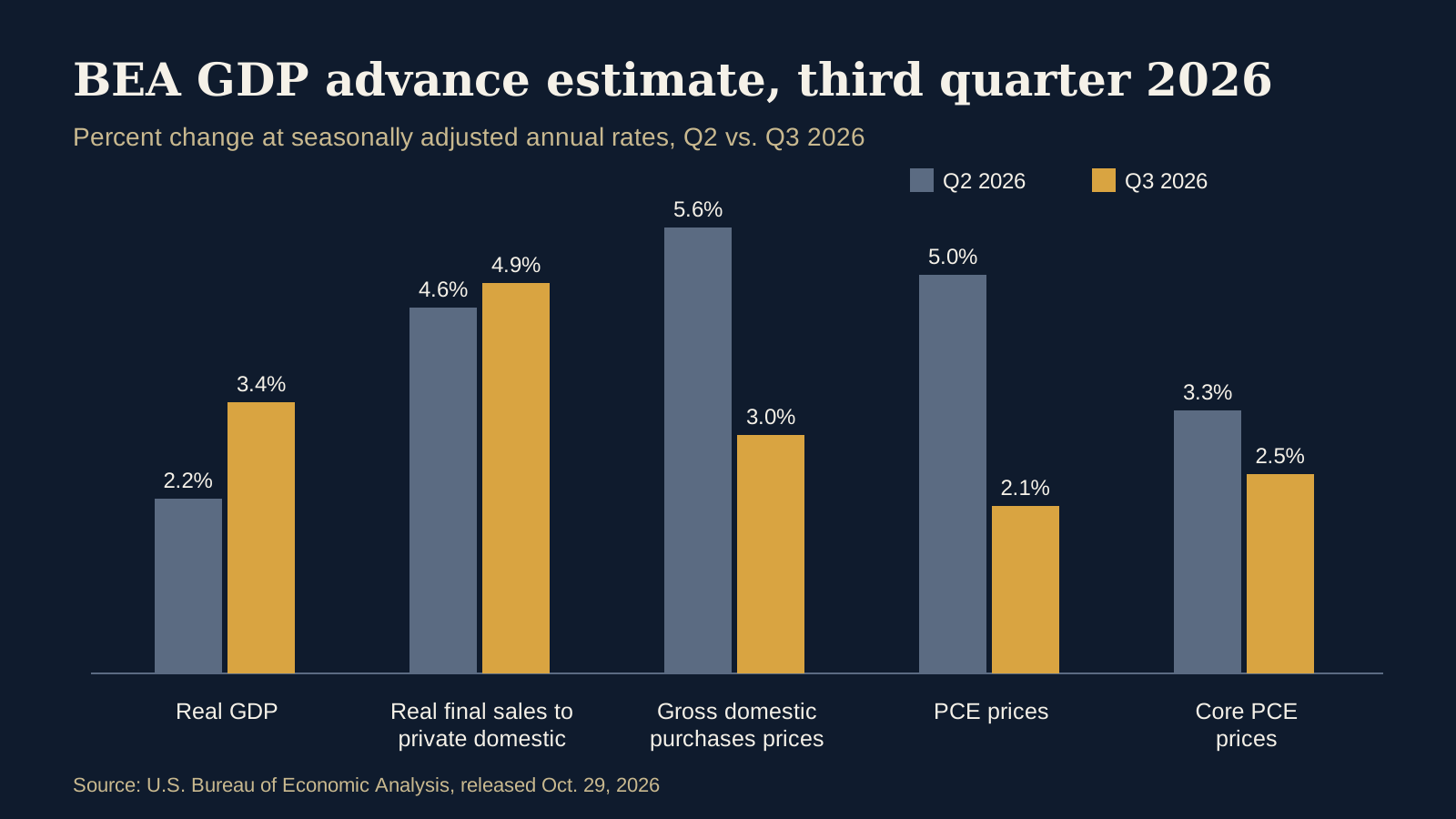
Real gross domestic product grew at a seasonally adjusted annual rate of 3.4% in the third quarter of 2026, up from 2.2% in the second quarter, the U.S. Bureau of Economic Analysis reported in its advance estimate at 8:30 a.m. ET on Thursday, Oct. 29, 2026. BEA said that equals 0.8% at a quarterly rate, according to its Q3 GDP advance estimate.
The annual rate shows what growth would be if the quarter's pace continued for a full year. It is not the change from a year earlier, and it is not the size of the quarter-to-quarter change, which BEA put at 0.8%.
What drove growth
BEA said increases in investment, consumer spending and government spending were partly offset by a decrease in exports. Imports, which are subtracted in the GDP calculation, increased. The investment gain mainly reflected private inventory investment and equipment, led by information processing equipment. Real final sales to private domestic purchasers, which combine consumer spending and private fixed investment, rose at a 4.9% annual rate, compared with 4.6% in the second quarter.
BEA's release text did not single out residential fixed investment as a main contributor. Readers who need that component can find it in BEA's linked contribution tables.
Price measures
| Measure | Q2 2026 | Q3 2026 |
|---|---|---|
| Real GDP | 2.2% | 3.4% |
| Real final sales to private domestic purchasers | 4.6% | 4.9% |
| Gross domestic purchases price index | 5.6% | 3.0% |
| PCE price index | 5.0% | 2.1% |
| PCE price index excluding food and energy | 3.3% | 2.5% |
Source: U.S. Bureau of Economic Analysis, GDP (Advance Estimate), 3rd Quarter 2026, released Oct. 29, 2026. Current-dollar GDP rose at a 5.6% annual rate.
These quarterly price figures are annualized averages for the quarter. They differ from the monthly and year-over-year PCE figures BEA released the same morning in its September personal income report, which showed prices up 3.6% from a year earlier.
What GDP can and cannot tell borrowers
GDP measures the economy's output. Faster growth and inflation readings are among the inputs investors use when pricing Treasury securities, and Treasury yields are one influence on mortgage rates. But GDP does not set mortgage rates, and a single advance estimate does not show how lenders will price loans. Treasury yields and mortgage rates are separate measures that often move differently.
The advance estimate is also the first of three. BEA will publish its second estimate, with corporate profits, on Nov. 25, 2026, and the figures can be revised as more complete source data arrive.
- Treat the advance estimate as preliminary.
- Base borrowing decisions on lender quotes and your own budget rather than a single macro release.
Cover: native chart by mortgage.news from BEA's published annualized rates.