Fed Holds at 3.75%–4.00% as Two Officials Favor a Hike: What Mortgage Borrowers Should Know
The Fed kept its policy rate at 3.75%–4.00% on October 28 in a 10–2 vote. Here's why mortgage rates may still move—and what buyers and refinancers should compare.
By Anthony Brikho · 5 min read
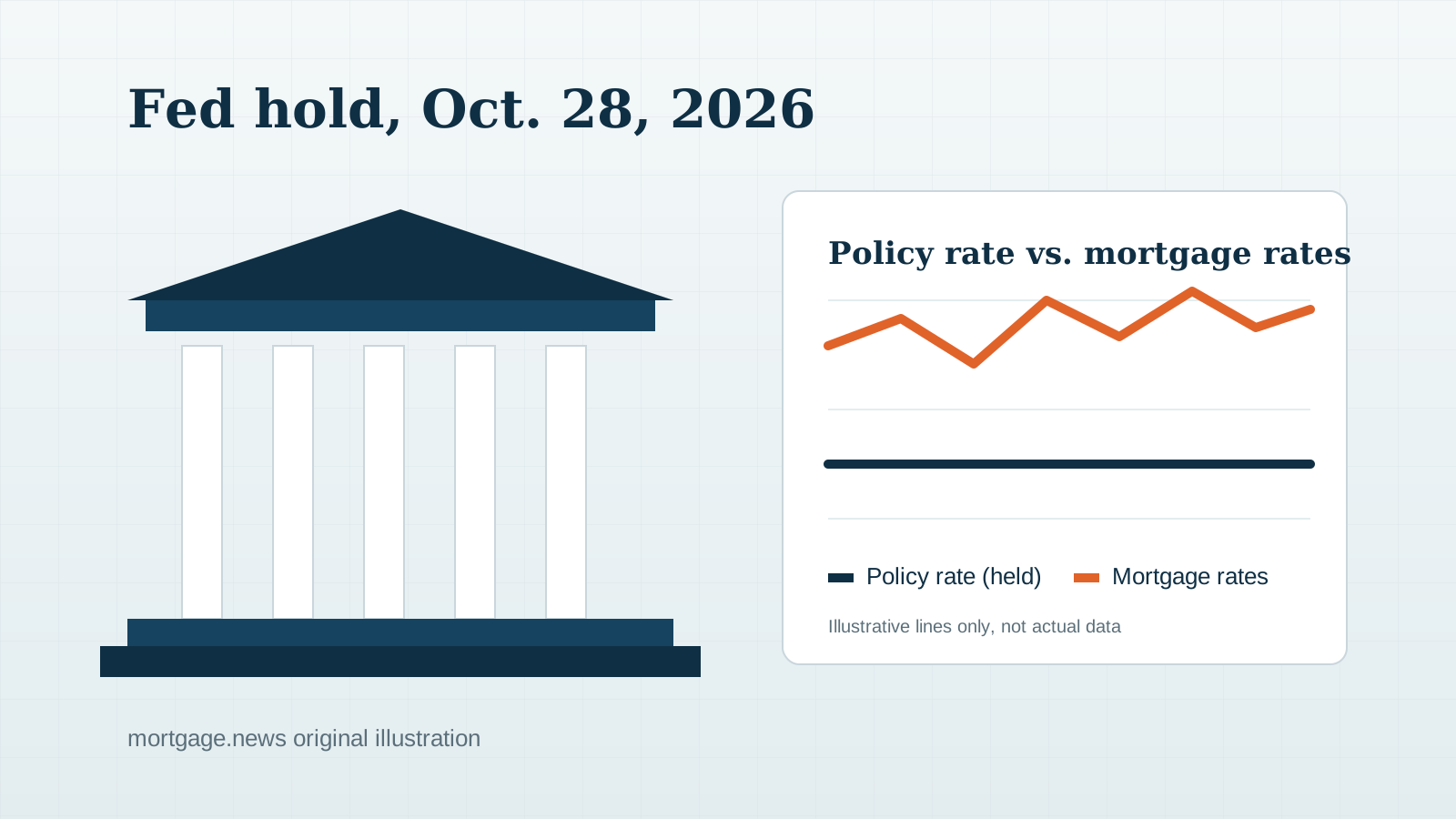
The Federal Reserve left its benchmark interest rate unchanged on Oct. 28, keeping the target range for the federal funds rate at 3.75% to 4.00%. The decision was not unanimous: the Federal Open Market Committee's statement records a 10–2 vote, with Governor Lisa D. Cook and Cleveland Fed President Beth M. Hammack preferring a quarter-point increase. For anyone shopping for a mortgage, the more useful question is not what the Fed did, but how much that decision actually reaches a home loan quote.
What the Fed decided
In its statement, the committee described economic activity as expanding at a strong pace and said inflation remains elevated. It said it will continue to gather more information as it weighs future adjustments. The majority chose to hold; the two dissenters favored tightening by 0.25 percentage point. A split of this kind shows a range of views inside the committee about how much restraint the economy needs. It is not, by itself, a commitment to any future move in either direction.
The Fed rate is not your mortgage rate
The federal funds rate is an overnight rate at which banks lend reserves to one another. A 30-year fixed mortgage is priced off a very different set of forces. Lenders generally look to longer-term Treasury yields and to what investors will pay for mortgage-backed securities, and those markets react to expectations about inflation, growth and future Fed policy, not only to the current target range. That is why mortgage rates can rise after a Fed cut, fall after a hold, or barely move at all on decision day.
On top of market pricing, an individual quote depends on the borrower's credit profile, down payment, loan program, property type, whether discount points are paid, lender fees and how long the rate is locked. Two people applying the same week can receive meaningfully different offers.
Where mortgage rates stand
The latest weekly reading available as of Thursday morning is Freddie Mac's survey for Oct. 22, which put the average 30-year fixed rate at 7.32% and the 15-year fixed rate at 6.68%, according to the Primary Mortgage Market Survey archive. A week earlier, on Oct. 15, the 30-year average was 7.40%. Freddie Mac's next weekly survey had not been released when this article was published, so it does not yet reflect any reaction to the Fed's latest statement. These figures are national averages, not quotes.
What a small rate change means in dollars
As an illustration only, and not an offer of credit, consider a $350,000 30-year fixed loan. At 7.40%, monthly principal and interest come to about $2,423.33. At 7.32%, the same payment is about $2,404.26, a difference of roughly $19 a month. Taxes, homeowners insurance, mortgage insurance and association dues are excluded, and actual terms vary by lender and borrower.
Practical steps for buyers and refinancers
- Compare Loan Estimates side by side. Request them for the same loan amount, term, loan type and lock period on the same day so differences reflect pricing rather than assumptions.
- Look beyond the headline rate. Review the APR, origination and lender fees, and any discount points.
- Calculate a breakeven for points. Divide the upfront cost of points by the monthly savings to see how many months it takes to recover, and weigh that against how long you expect to keep the loan.
- Weigh fixed versus adjustable carefully. An adjustable-rate loan may start lower, but understand when and how much the payment can change before choosing it.
- Time your lock to your closing. A longer lock may cost more; a lock that expires early can be costly to extend.
What to watch next
For mortgage rates, the signals that matter most in the weeks ahead are fresh inflation data, moves in longer-term Treasury yields and conditions in the mortgage-backed securities market. Freddie Mac's next weekly survey will offer the first read on whether average rates shifted after the meeting, and the committee's next scheduled meeting will show whether the views of the two dissenters gain ground. No one can say with certainty where rates go from here; borrowers are better served by comparing complete offers than by waiting on a forecast.