Mortgage Rates Fall to 7.24% for a Second Week, but Buyers Still Face a Steep Payment Gap
Freddie Mac's 30-year average fell to 7.24% on October 29, its lowest October reading. The drop helps monthly payments, but rates remain well above a year ago.
By Anthony Brikho · 5 min read
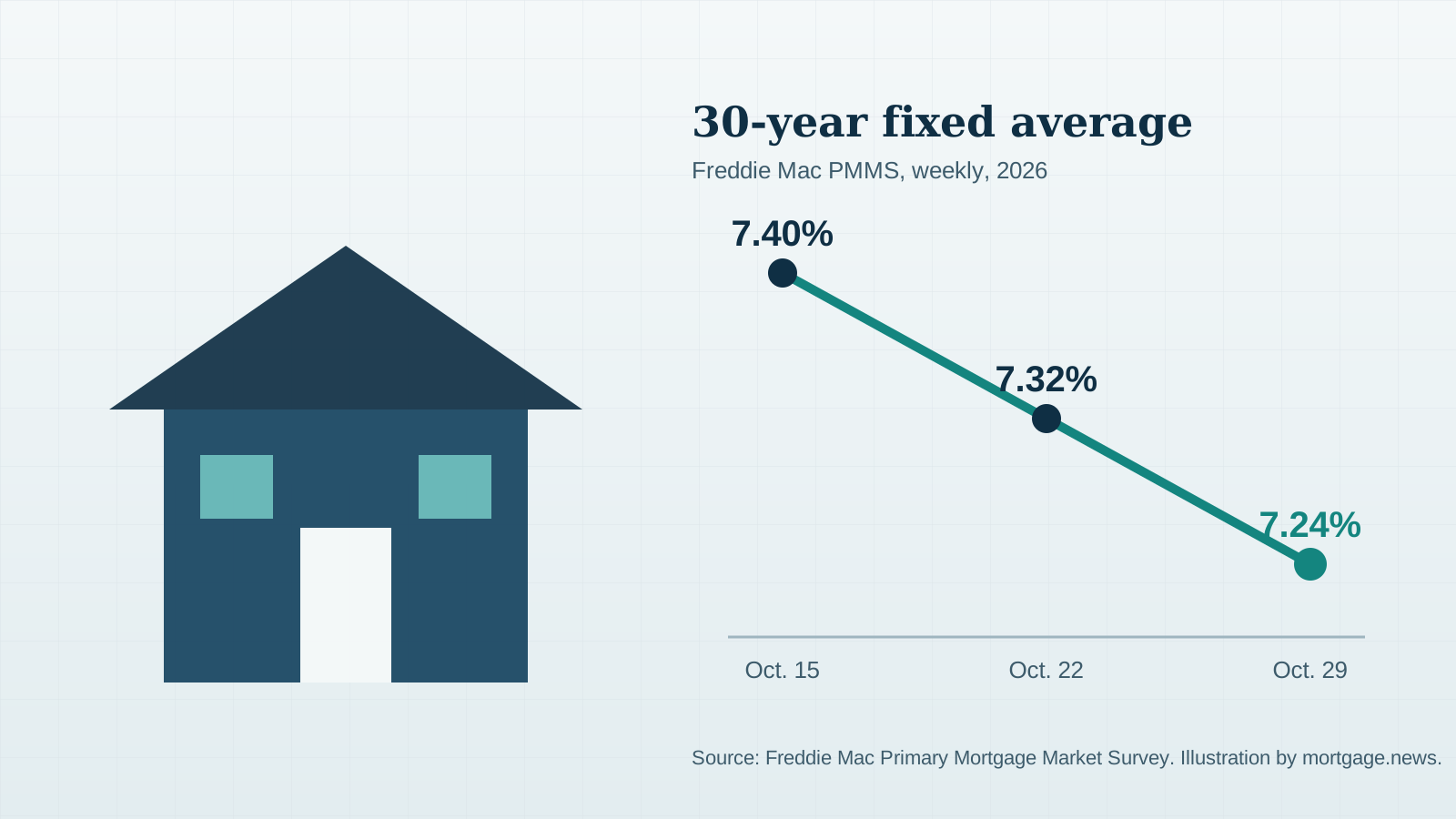
Mortgage rates retreated for a second consecutive week, offering homebuyers some breathing room after a sharp early-autumn climb. Freddie Mac's Primary Mortgage Market Survey put the average 30-year fixed mortgage at 7.24% on October 29, 2026, down from 7.32% a week earlier and 7.40% on October 15. Freddie Mac described the reading as the lowest level this month, although borrowing costs remain elevated compared with a year ago.
What the latest survey shows
The 15-year fixed mortgage also declined, averaging 6.60% versus 6.68% the previous week. For context, Freddie Mac reported 30-year and 15-year averages of 6.17% and 5.41%, respectively, at the same time last year. The new weekly averages represent an eight-basis-point decline in both loan categories, not a return to the cheaper financing available earlier in 2026.
| Week | 30-year fixed | 15-year fixed |
|---|---|---|
| Oct. 15 | 7.40% | 6.71% |
| Oct. 22 | 7.32% | 6.68% |
| Oct. 29 | 7.24% | 6.60% |
Source: Freddie Mac PMMS archive, as of Oct. 29, 2026.
Freddie Mac's survey is a national benchmark built from lender applications, released weekly on Thursdays. It is not a guaranteed quote. Actual offers can vary with credit, loan-to-value ratio, property, occupancy, discount points, loan program and lender pricing. The methodology and current figures are published by Freddie Mac, with historical observations in its rate archive.
How much does eight basis points save?
For a hypothetical $400,000 mortgage with a 30-year fixed term, principal and interest at 7.32% are approximately $2,748 per month. At 7.24%, that becomes roughly $2,726, a difference of about $22 per month or about $261 over 12 months. This example assumes the same loan amount and amortization schedule, excludes taxes, insurance, mortgage insurance and fees, and does not imply that an individual borrower can lock either survey rate.
The broader rate swing is more consequential. At 7.40%, the same $400,000 loan would have principal and interest near $2,770. The October 29 average trims that by roughly $44 monthly. But compared with a hypothetical 5.98% rate, the 7.24% payment is roughly $333 higher each month. These calculations underscore why small weekly improvements can help without fully repairing affordability.
Why a Fed decision does not set your mortgage rate
The Federal Reserve's October 28 decision to hold its short-term policy target does not mechanically set 30-year mortgage pricing. Mortgage rates are influenced by longer-term Treasury yields, mortgage-backed securities, inflation expectations, investor demand and lender margins. Markets can move before or after a Fed announcement as investors reassess the path of inflation and economic growth. A stable policy rate can coexist with falling or rising mortgage quotes.
For borrowers, the practical implication is to avoid assuming that one central-bank announcement determines the best day to lock. The right decision depends on closing timing, risk tolerance and the complete Loan Estimate.
What buyers and homeowners should do now
A lower national average can create an opening for buyers who have already identified an affordable payment, but purchasing power should be tested against the full housing budget: principal, interest, property taxes, homeowners insurance, any association dues, mortgage insurance and a reserve for maintenance. Freddie Mac's homebuyer education resources explain how rate changes affect affordability.
Borrowers comparing lenders should request same-day quotes with identical loan amount, term, lock period, property assumptions and points. Compare APR, lender credits, origination charges, cash needed at closing and the monthly payment rather than headline rates alone. Paying points to reduce a rate only makes sense when the expected holding period and break-even calculation support the upfront cost.
For existing homeowners, a refinance deserves a separate calculation. Compare the new principal balance, closing costs, term reset, total interest and time needed to recoup the expense. A modestly lower rate does not automatically mean the refinance improves long-term finances. Cash-out transactions also increase secured borrowing and can change the risk profile of household debt.
The bottom line
Freddie Mac's latest survey provides a welcome second week of relief, but 7.24% is still more than a full percentage point above the year-earlier 30-year average. The news is a modest improvement in borrowing conditions, not a broad affordability reset. Buyers and refinancers are better served by comparing the full cost of financing and acting on a payment they can comfortably sustain than by trying to predict the next weekly rate move.
Source: Freddie Mac Primary Mortgage Market Survey, released October 29, 2026. Calculations are illustrative, principal-and-interest only. Cover: original illustration by mortgage.news from Freddie Mac's published weekly averages.