Before You Wire Closing Funds, Make This Verification Call
Save trusted contacts early, verify the account through an independent call, and confirm receipt immediately. A familiar email thread is not enough.
By Gino Yatouma · 3 min read
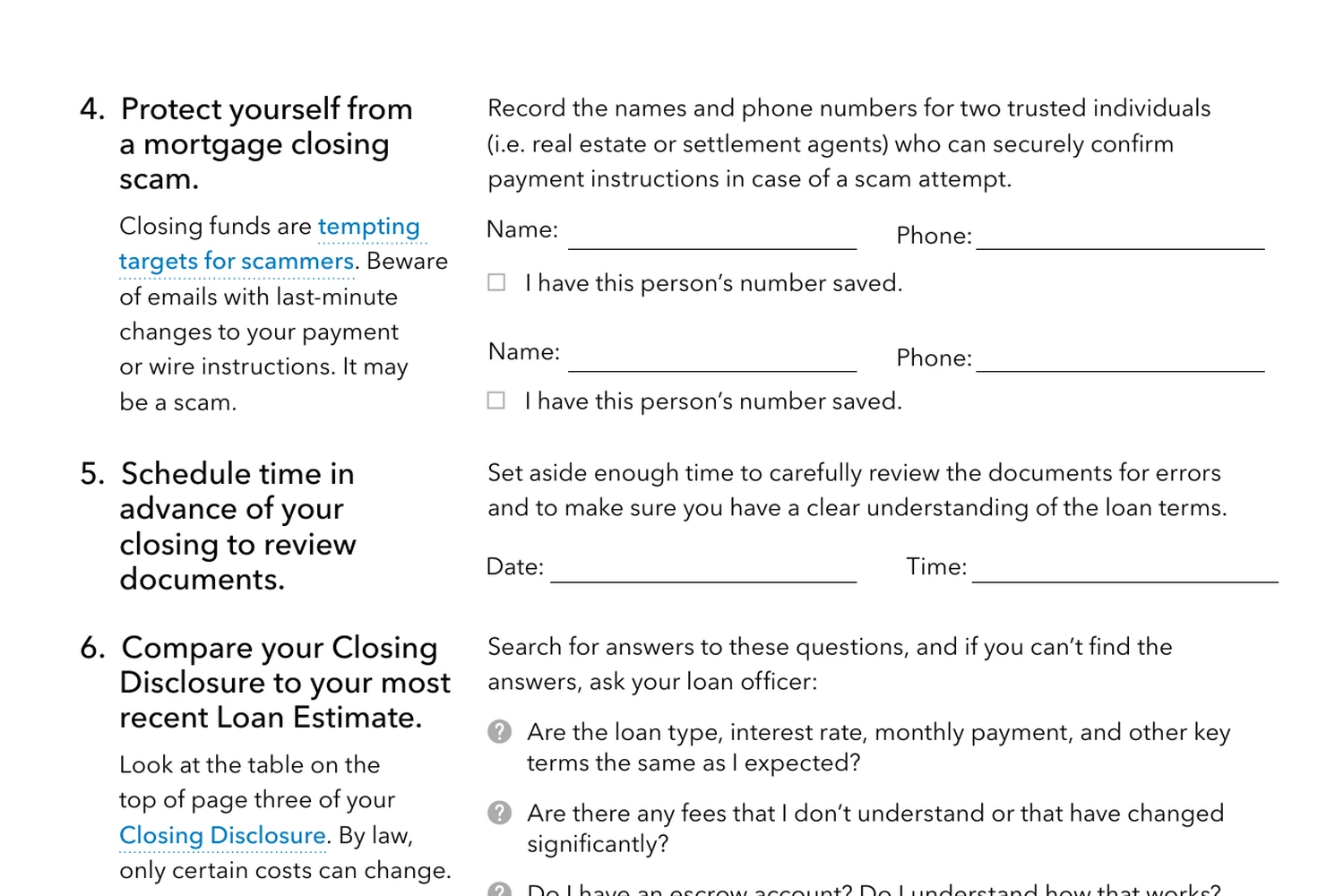
Why this matters: Closing funds are a target for email scams. A call to a number you set up yourself, before and after you send the wire, is the step that protects the money.
Cover: Page 3 of the CFPB mortgage closing checklist, which includes space to record trusted contacts before wiring funds. Source: Consumer Financial Protection Bureau, public-domain government content.
Before sending your down payment or closing costs, confirm the wiring instructions through a phone number you established independently with the closing office. If an email supplies new instructions and a new number to call, using that number does not provide independent verification.
The FBI's business email compromise guidance includes a homebuyer receiving fraudulent down-payment instructions as a real example of this crime. Criminals can imitate addresses or gain access to legitimate messages, so familiar names and transaction details are not proof that a payment request is genuine.
Set up your trusted contacts early
Before closing day, identify who at the settlement or title company can confirm payment instructions. Save the person's name and primary phone number after establishing them through a trusted channel. Ask how the office normally delivers instructions and how it handles any change.
The CFPB's mortgage closing checklist includes space for two trusted contacts who can help confirm payment details. Completing that section ahead of time means you have a reference ready when a message arrives under deadline pressure.
Ask about the bank's sending deadline too. Build verification into the schedule instead of treating it as a task to squeeze in after the wire is prepared.
Verify the destination before sending
Call the closing office using the number you previously established. Confirm the account name and number and the other wire details the office requires. The CFPB's specific scam guidance recommends confirming the instructions in person or with your trusted representative through the previously agreed phone number.
Older context: the American Land Title Association's consumer video, published July 18, 2017 (1:59), on protecting closing money from wire fraud schemes. The advice is longstanding; check current procedures with your own closing office.
A practical call can begin: “I'm preparing to send my closing funds. Please confirm the approved instructions with me.” Work through the details rather than asking only whether an email “looks right.” Confirm the amount due with the closing team as well.
If the instructions change, pause and repeat the independent verification. The FBI specifically advises checking changes in account numbers or payment procedures and being cautious when someone presses you to act quickly.
Confirm receipt with the closing office
After sending a legitimate wire, keep your confirmation and call the recipient promptly through the trusted number. The National Association of Realtors' consumer guide recommends confirming receipt immediately. A sending-bank confirmation should not be your final checkpoint.
If the closing office cannot confirm receipt, tell your bank immediately and explain the concern. Do not wait for a reassuring reply in the same email thread that prompted the payment.
If you suspect the money went to a criminal
Contact the sending financial institution immediately and request urgent action, including a wire recall. The FBI says to ask it to contact the receiving institution and to report the incident at IC3.gov. Preserve the messages, transfer confirmation, and timing information for the report.
The Federal Trade Commission also advises reporting a fraudulent bank wire immediately and asking whether it can be reversed. Recovery is not guaranteed. Acting promptly gives the institutions and investigators a chance to respond while you document what happened.