A Cash-Out Refinance Can Lower Your Payment and Still Cost More Over Time
Using home equity to pay off credit cards can shrink the monthly bill. Check the total interest, fees, payoff date and the new risk to your home first.
By Joseph Salem · 3 min read
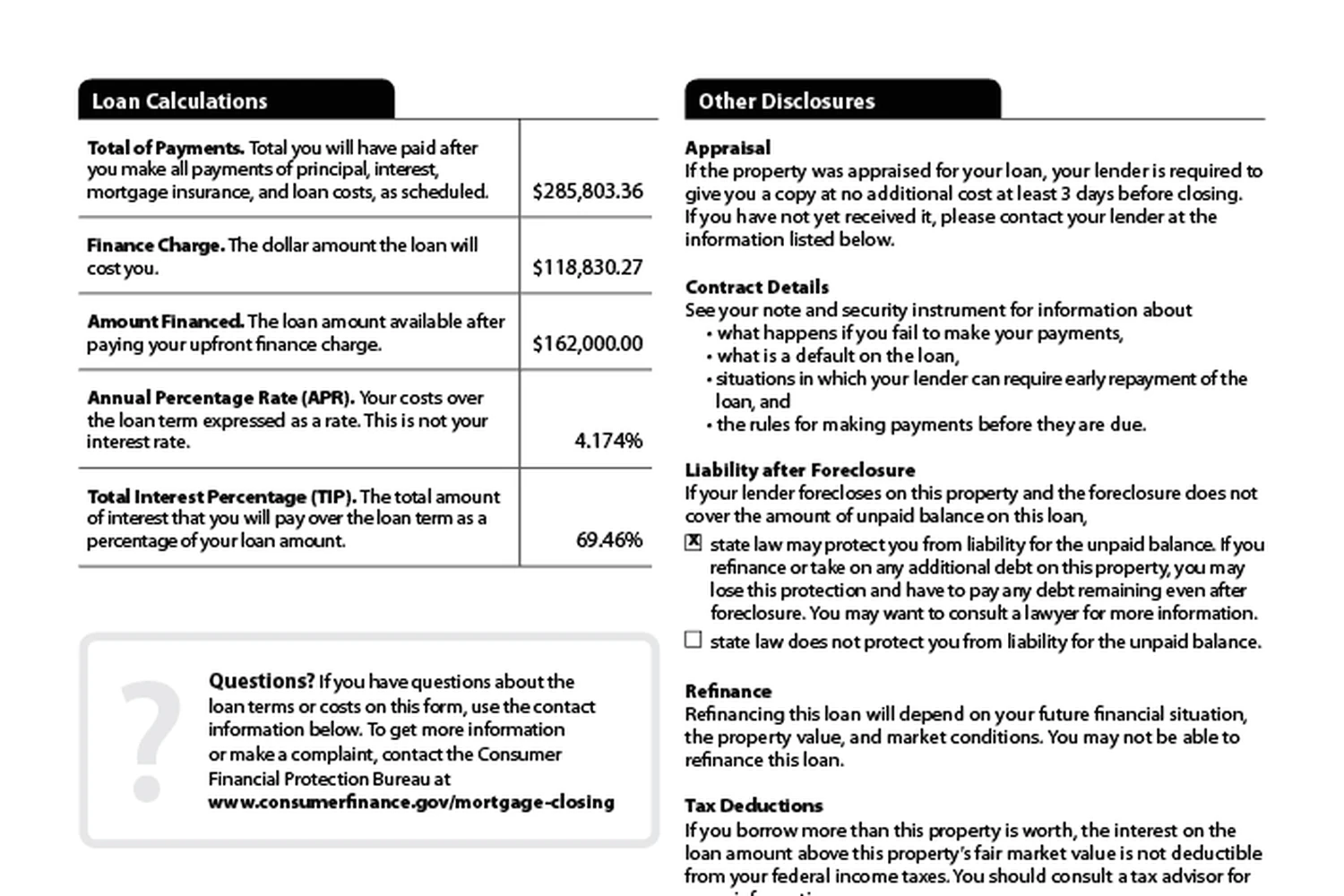
Why this matters: A smaller combined payment can still cost more in total. Compare the whole new loan, its fees and its payoff date with keeping your current mortgage, before turning card debt into debt secured by your home.
Cover: Loan calculations section of a CFPB sample Closing Disclosure. Illustrative sample form, not a loan offer. Source: Consumer Financial Protection Bureau, public-domain government content.
A cash-out refinance used to pay off credit cards can make a household budget feel much more manageable. But the difference between your old monthly bills and your new payment is only the first number to check. The repayment timeline, fees, and risk to your home can change too.
The useful comparison is the cost of keeping your existing mortgage and paying down the other debts versus the cost of the entire proposed refinance. Comparing a credit card's rate with a mortgage rate alone misses part of that calculation.
The new rate applies to the mortgage you replace
With a cash-out refinance, you replace your existing mortgage with a larger loan and receive the remaining proceeds after payoffs and costs. The CFPB says to examine closing costs and the new interest rate, especially when that rate is higher than the rate on your current mortgage. Its comparison of home-equity borrowing options explains why a cash-out refinance may be more or less expensive than a separate home-equity loan or line.
For example, borrowing an additional $30,000 does not mean only $30,000 receives the new rate. Your existing mortgage balance is refinanced as well. Ask for a side-by-side calculation that includes both balances, all closing charges, and any costs added to the new loan.
A smaller payment can hide a longer payoff
Consider an illustration involving only a $30,000 debt balance. At a fixed 20% annual rate, paid off with equal payments over five years, the payment is about $795 a month and total interest is about $17,689. At a fixed 6% rate over 30 years, the payment is about $180, but interest totals about $34,751.
Older educational context: Clear Money Talk's Tim Clairmont and Tyler Andrews, of a financial-planning firm, discuss HELOC and cash-out refinance tradeoffs, published August 3, 2026 (28:52). Their August rate discussion does not describe October 4 conditions.
These are arithmetic examples, not available loan offers. They assume monthly payments, no fees, no additional borrowing, and no early payments. They isolate the effect of repayment length; a real cash-out comparison must also include the original mortgage. Actual credit-card minimum payments do not generally follow this fixed five-year schedule.
The example illustrates the CFPB's warning about debt consolidation: payment relief can come from extending repayment, which can increase the overall amount paid.
Credit-card debt becomes debt secured by your home
Moving an unsecured card balance into a mortgage changes what is at stake if repayment fails. In its January 2025 cash-out refinance research summary, the CFPB cautions that replacing non-mortgage debts with mortgage debt can increase foreclosure risk. The study described borrowers from 2014 through 2021; it is historical context, not a prediction of your outcome.
Consolidation also does not remove the conditions that produced the debt. A plan needs room for regular expenses and unexpected bills so card balances do not rebuild beside the larger mortgage.
Ask for two payoff plans
Request one calculation using only the required new payment and a second using any extra principal payment you realistically intend to make. For each, compare fees, total interest, the payoff date, and the balance remaining after your expected time in the home.
The CFPB's Closing Disclosure guide explains that rolling closing costs into the loan adds interest expense. Check the loan amount, monthly payment, and closing costs against the offer. A refinance can provide useful breathing room, but its value depends on what that relief costs and whether the new payment fits a durable household budget.